Qeridoo magazine

Helmet in the bicycle trailer: regulations and tips for parents

The bicycle trailer is considered one of the safest transport options for children from six months of age. Although there is no helmet requirement everywhere, wearing a helmet in the bicycle trailer is strongly recommended. We have summarized the most important regulations and tips for you on how you can protect your child optimally.

Nikolai Boldt

CEO

The key points in brief

Bicycle helmets for children

Even if wearing helmets in bicycle trailers for children is not mandatory everywhere, it is still strongly recommended. It increases the safety of the little ones and can prevent head injuries.

When searching for the right bicycle helmet for your child, the following features should be considered:

 Fit: The helmet must fit well and must not slip. It should sit snugly but not pinch. A helmet that is flattened in the back is best suited for child bicycle trailers.
 Adjustment: The fit of the helmet should be easily adjustable so it sits optimally. So the helmet can also grow with your child.
 Visibility: Reflective elements increase visibility in road traffic. Bright colors and designs make the helmet even more conspicuous and also appealing to your child.
 Crash protection: Check the helmet regularly for damage and replace it after every crash. Never buy helmets second-hand.

Helmet requirement and recommendations

Do children in the bicycle trailer need a helmet?


No mandatory helmet in Germany

Currently there is in Germany no legally required helmet requirement for cyclists. The legislator relies here on the personal responsibility of parents. Even in an accident not caused by their own fault, cyclists without a helmet are not partly to blame for a head injury.

Bicycle helmet in the bicycle trailer: mandatory helmet in Austria
In Austria, children under 12 years must according to the Austrian bicycle regulation wear a helmet (helmet requirement). This applies regardless of whether they ride themselves or are taken along in the bicycle trailer or bicycle seat.
Children in the bicycle trailer: helmets in Switzerland not mandatory
Similar to Germany, in Switzerland there is also no legal helmet requirement for cyclists, including children in the bicycle trailer. The decision lies with the parents whether they put a helmet on their children in the trailer or bicycle seat.

The supervising adult is responsible for ensuring that the child wears the helmet. In addition, children in the trailer must be buckled in and protected from contact with spokes and the roadway.


Where does the responsibility lie?

Helmet in the bicycle trailer: responsibility of parents

The bicycle trailer is a popular means of transport for children, as it is particularly practical and very safe in everyday life. A helmet in the trailer additionally increases safety and reduces the risk of injury in accidents.

Although there is no helmet requirement everywhere, it is strongly recommended that children in the bicycle trailer wear a helmet. This responsibility lies with the parents, who should also themselves set a positive example.

Helmet in the bicycle trailer: ADAC and ADFC recommendation

Studies by ADAC accident research show that helmets effectively protect against head injuries in falls. The ADFC also recommends wearing a helmet in the bicycle trailer.

A helmet distributes the impact force over a larger area, so individual spots are less heavily stressed. This way severe head injuries can be reduced or even avoided.

Child with helmet in the bicycle trailer
ADAC and ADFC recommend wearing a helmet in the bicycle trailer to increase safety.
Safety is paramount at Qeridoo

Our bicycle trailers offer your child, thanks to numerous features, a high level of safety. For example, the special geometry of our child bicycle trailers and the low center of gravity ensure maximum stability. More on the topic of safety at Qeridoo is shown in our following video:

Our innovative and patented head protectors offer optimal protection by ensuring, in case of a tip-over, a vital safety distance between your child's head and the ground. In addition, the push handle serves as a roll-over protection.

Despite these measures, it is important that your child in the trailer is additionally protected with a bicycle helmet. Even if there is no helmet requirement in Germany, we therefore recommend wearing a helmet in the bicycle trailer 100 percent. For your child's safety!

Baby transport

Does a baby need a helmet in the bicycle trailer?

Children who can sit independently should wear a helmet in the bicycle trailer. For infants who are still transported in an infant carrier or hammock, wearing a helmet is not advisable.

The little head cannot rest properly with a helmet, which over-strains the neck muscles. As soon as your child can sit independently and upright without a seat insert, they should, however, wear a helmet.

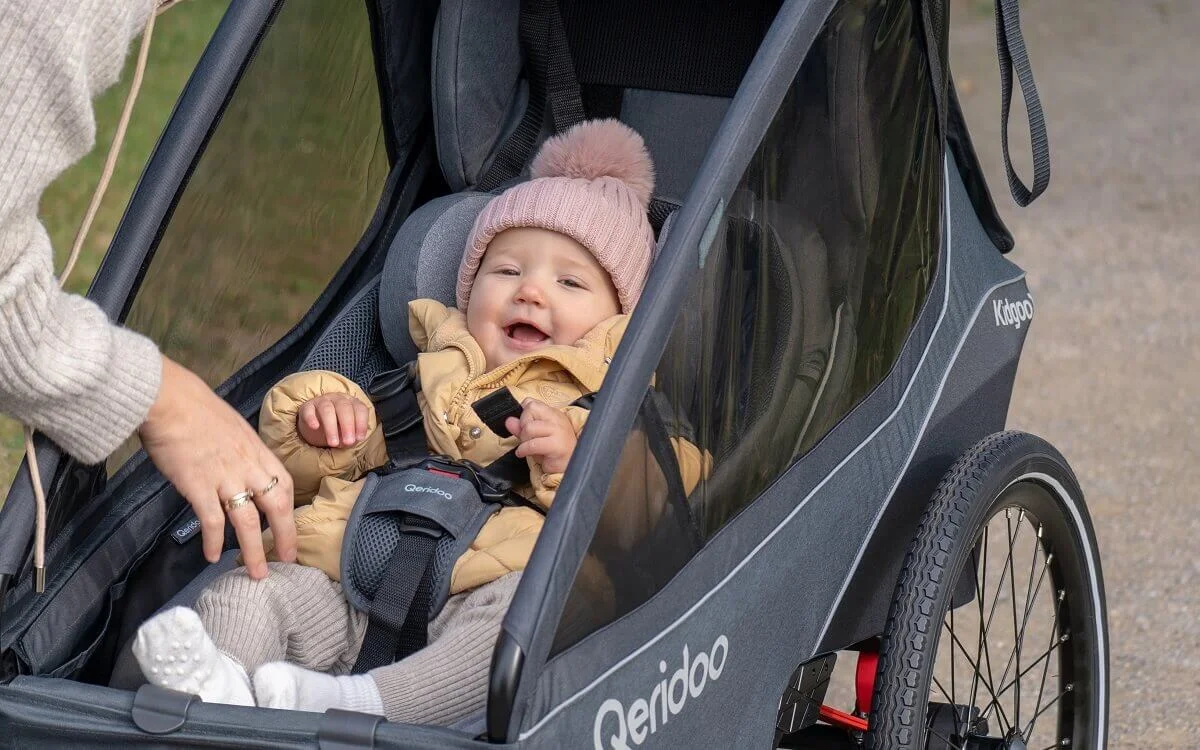
Child in the bicycle trailer
As soon as your child can sit independently, they should wear a helmet in the bicycle trailer.
Buying guide for child bicycle helmets

Bicycle helmet in the trailer: what to consider when buying

So that the bicycle helmet optimally protects your child's head from injuries in case of a fall, when buying it is important to consider a few important points. Here wearing comfort also plays a big role.

Helmet for bicycle trailer: the right fit

The fit of the helmet is decisive. The helmet must fit well and must not slip, in order to ensure optimal protection . It should sit snugly but not pinch, so no headaches arise. Ideal is a helmet that can keep up with the rapid growth of your child.

The helmet should sit centrally on your child's head and cover half of the forehead to protect the upper and back of the head as well as the temples. The ears and face must not be covered .

Additionally, the helmet should sit firmly and not slip over the forehead or into the neck. In a fall otherwise the helmet itself in the bicycle trailer could cause injuries.

Finding the right helmet: try on in advance

Children should therefore be present when buying the helmet, so the right fit is guaranteed and your child likes to wear the helmet. Additionally, they can help choose the look of the helmet – an important point for children, so they also want to wear the helmet.

Important: You should never buy helmets second-hand! ADAC and TÜV tests recommend in addition replacing the helmet every five years
. After a fall the helmet must be disposed of and a new one bought, as its protective function is no longer ensured.

Bicycle helmet: wearing comfort in the bicycle trailer

The helmet shape should be flattened in the back as much as possible, so your child's mobility is not impaired and the head can be leaned back comfortably. Pleasant padding inside the helmet additionally protects your child's head against pressure points and increases wearing comfort.

Wearing a bicycle helmet: visibility is important

The helmet should be equipped all around with reflectors and LED lighting to increase visibility. Bright, conspicuous colors and designs make the helmet not only more attractive for your child. They also improve visibility and prevent excessive heating from sun rays.

Our conclusion

Definitely wear a helmet in the bicycle trailer

We recommend that children in the bicycle trailer always wear a helmet, even if there is no legal requirement. A helmet offers additional protection in accidents and minimizes the risk of head injuries.

In combination with our safe Qeridoo bicycle trailers for children, which feature head protectors and roll-over protection, your child is thus optimally protected.

Important: Also lead by example yourself and always wear a helmet yourself! That way you can playfully teach your child that wearing a helmet is also really cool for moms and dads.

Last updated: February 4, 2026

FAQ – Die häufigsten Fragen zu Helm im Fahrradanhänger

Müssen Kinder im Fahrradanhänger einen Helm tragen?

In Deutschland gibt es keine gesetzliche Helmpflicht für Kinder im Fahrradanhänger – der Gesetzgeber setzt auf die Eigenverantwortung der Eltern. In Österreich hingegen sind Kinder unter 12 Jahren laut Fahrradverordnung verpflichtet, einen Helm zu tragen – auch im Fahrradanhänger oder Fahrradsitz. In der Schweiz besteht ebenfalls keine gesetzliche Helmpflicht.

Ja, dringend. Sowohl ADAC als auch ADFC empfehlen das Tragen eines Helms im Fahrradanhänger ausdrücklich. Studien der ADAC Unfallforschung zeigen, dass Helme bei Stürzen effektiv vor Kopfverletzungen schützen, indem sie die Aufprallkraft auf eine größere Fläche verteilen. Qeridoo empfiehlt das Tragen eines Helms zu 100 Prozent – zusätzlich zu den integrierten Sicherheitsfeatures der Anhänger.

Am besten geeignet ist ein hinten abgeflachter Helm für den Fahrradanhänger. Diese Form ermöglicht es dem Kind, den Kopf bequem an die Rückenlehne anzulehnen, ohne dass der Helm drückt oder die Haltung beeinträchtigt. Eine angenehme Innenpolsterung, einfache Verstellbarkeit und reflektierende Elemente für mehr Sichtbarkeit sind weitere wichtige Merkmale.

Der ADAC empfiehlt das Tragen eines Helms im Fahrradanhänger und belegt mit Studien der eigenen Unfallforschung, dass Helme bei Stürzen nachweislich vor Kopfverletzungen schützen. Eltern tragen in Deutschland die Verantwortung für die Helmnutzung ihrer Kinder und sollten selbst als Vorbilder vorangehen.

ADAC und TÜV empfehlen, den Helm alle fünf Jahre zu ersetzen. Nach jedem Sturz – auch wenn äußerlich keine Schäden sichtbar sind – muss der Helm sofort ausgetauscht werden, da die Schutzfunktion nicht mehr zuverlässig gewährleistet ist. Helme sollten außerdem regelmäßig auf Risse oder Beschädigungen kontrolliert werden.

Qeridoo Anhänger bieten durch patentierte Kopfprotektoren, einen tiefen Schwerpunkt, den Schiebebügel als Überrollschutz und ein 5-Punkt-Gurtsystem ein hohes Maß an Sicherheit. Diese Features ersetzen jedoch keinen Helm – Qeridoo empfiehlt ausdrücklich, dass Kinder ab dem Sitzalter zusätzlich immer einen Helm tragen.

In Deutschland droht aktuell keine gesetzliche Strafe, da keine Helmpflicht besteht. In Österreich hingegen ist das Tragen eines Helms für Kinder unter 12 Jahren gesetzlich vorgeschrieben – ein Verstoß kann entsprechend geahndet werden. Unabhängig von gesetzlichen Vorgaben empfiehlt Qeridoo den Helm in jedem Fall.