Baby insert in the bicycle trailer: infant carrier vs. hammock
When transporting babies in the bicycle trailer, parents often face the choice between using an infant carrier or a hammock. Both options offer different advantages regarding safety, comfort and flexibility. In this guide we compare the two systems to help you find the ideal baby insert for your bicycle trailer.
Hammocksoffer optimal
comfort and freedom of movement through their flexible adaptability for toddlers who cannot yet sit
independently.
For newborns and younger babies who still need lots of
support, an infant carrier is the ideal choice. For older babies who
prefer a comfortable and adjustable lying position, we recommend
the hammock instead.
Safety
Infant carrier in the bicycle trailer: safety and protection for the smallest
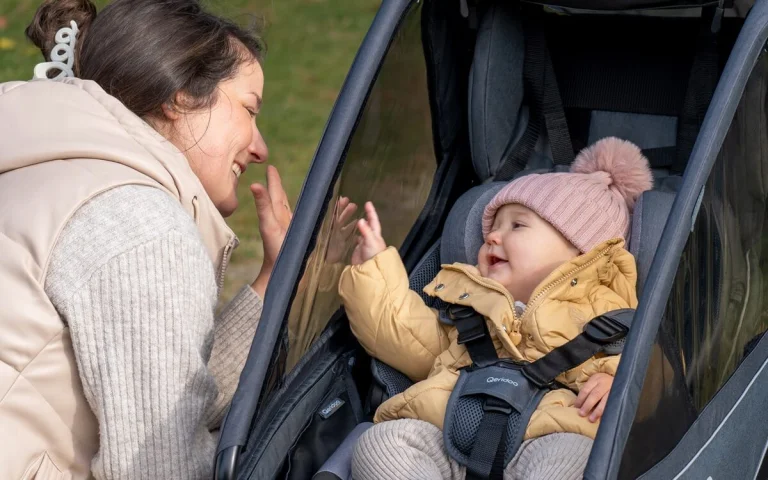
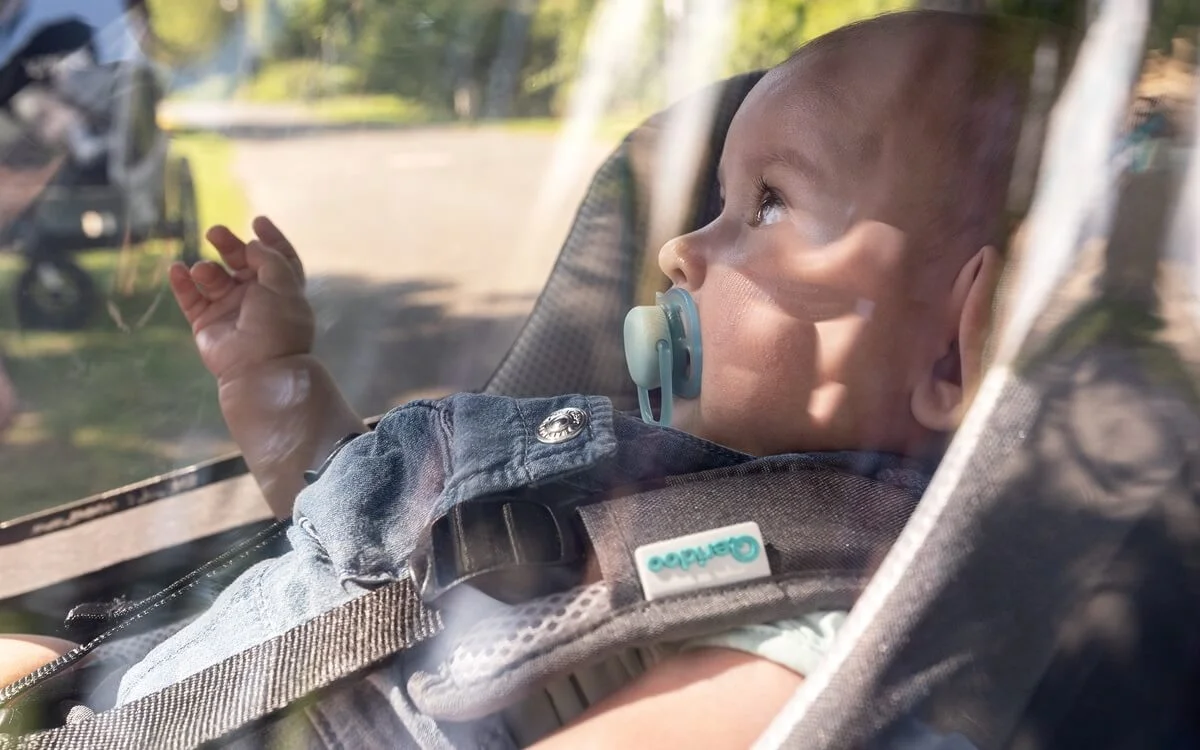
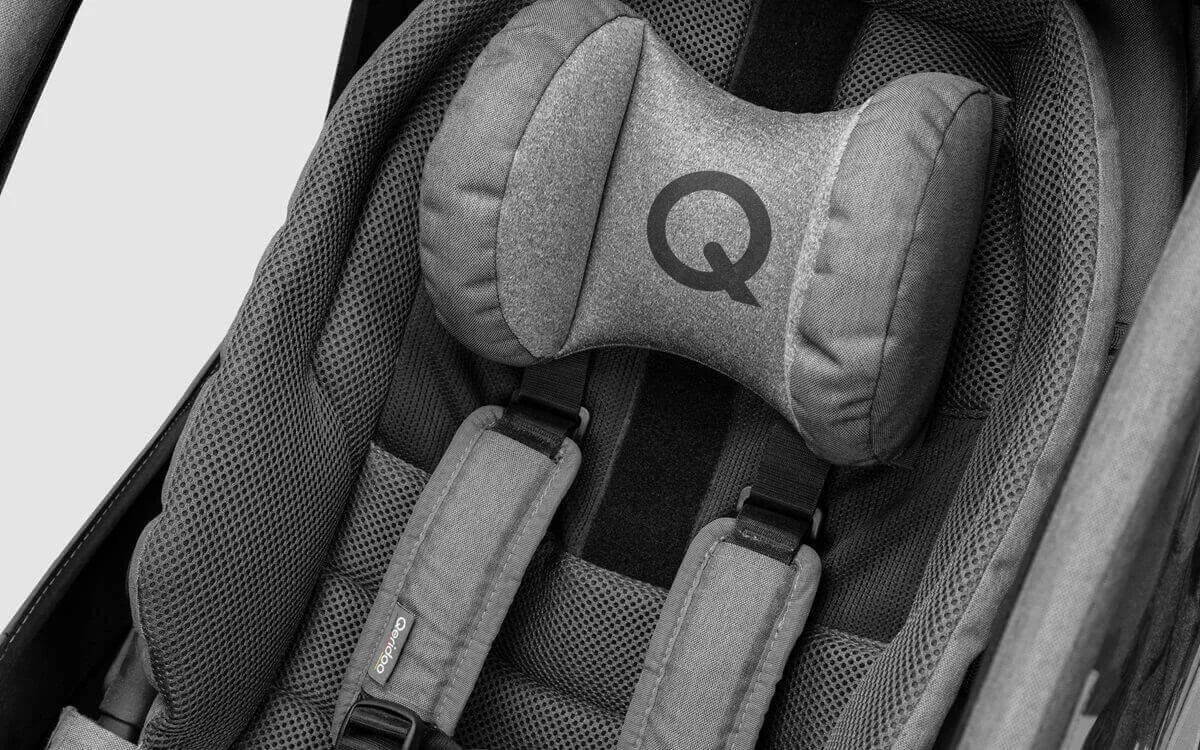
For baby transport , the highest protection is indispensable. The infant carrier has been optimized from a classic car seat specifically for baby transport and ensures a safe and comfortable ride in the bicycle trailer for your baby from the 4th week of life until independent sitting.
High safety and ergonomic design with the Qeridoo infant carrier
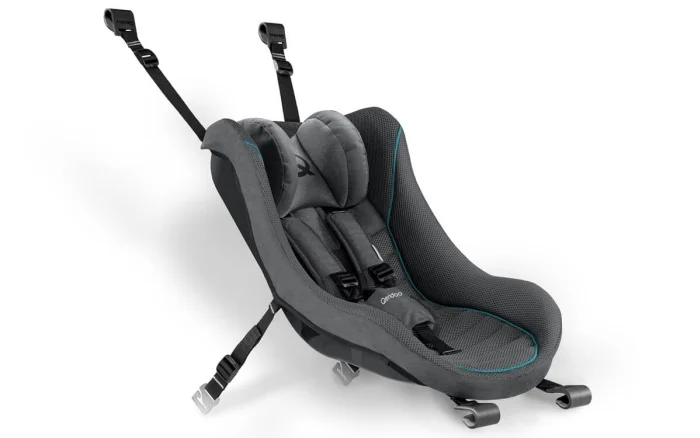
Our infant carrier is equipped with an adjustable 5-point safety harness with Smart Lock function
, which secures your baby safely and ensures an optimal protective position.
The height-adjustable headrest and the side impact protection offer comprehensive protection
for the sensitive head and neck area as well as for the
trunk of your baby. The ergonomic lying position ensures a
back-friendly posture of head and back and thereby guarantees a
comfortable and safe ride.
Comparison
Baby transport in comparison: infant carrier vs. hammock
When choosing between an infant carrier and a hammock for the
bicycle trailer, several factors should be considered.
Whether you best transport your child in the hammock or infant carrier depends on several factors.
For safety reasons, please absolutely adhere to the recommended weight limits and age restrictions.
Thanks to the floating mounting, an additional spring effect
is achieved that reduces vibrations. The soft padding ensures
maximum comfort. Through the special attachment system, the
infant carrier can be effortlessly and safely mounted in the bicycle trailer.
To safely attach the infant carrier in the bicycle trailer,
place it centrally to optimally maintain balance. Make
sure to pull all harnesses tight and regularly check the attachment points
for secure hold.
Infant carrier or hammock: the right choice for your child's age
Newborns and very young babies who still
need lots of support for head, neck and back,
are better off in an infant carrier. It offers the necessary
stability and safety that is particularly important in the first months of life
. Infant carriers are designed specifically for smaller babies and
ensure an ergonomic lying position that optimally supports the child's body
.
The infant carrier is particularly suitable for newborns, the hammock for already slightly older children.
For older babies who already have more control over their body and
prefer a more comfortable, adjustable lying position,
a hammock is ideal. It offers more freedom of movement and comfort and
still ensures a safe ride.
Infant carrier
Safety
High safety thanks to 5-point harness system and fixed position
Bicycle trailer infant carrier - all advantages at a glance:
High safety: The padded 5-point harness system
secures the baby safely.
Ergonomic: Optimally supports head and back.
Additional protection: Height-adjustable headrest and side impact protection.
Comfort: Soft padding ensures comfort.
Easy mounting: Easy installation and removal in the trailer.
Transport baby with the hammock in the bicycle trailer
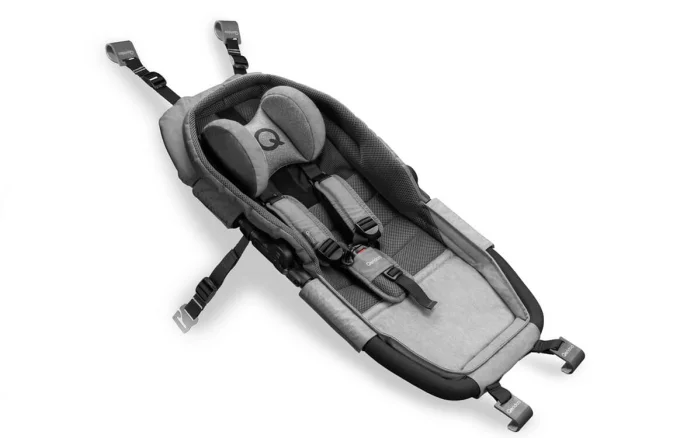
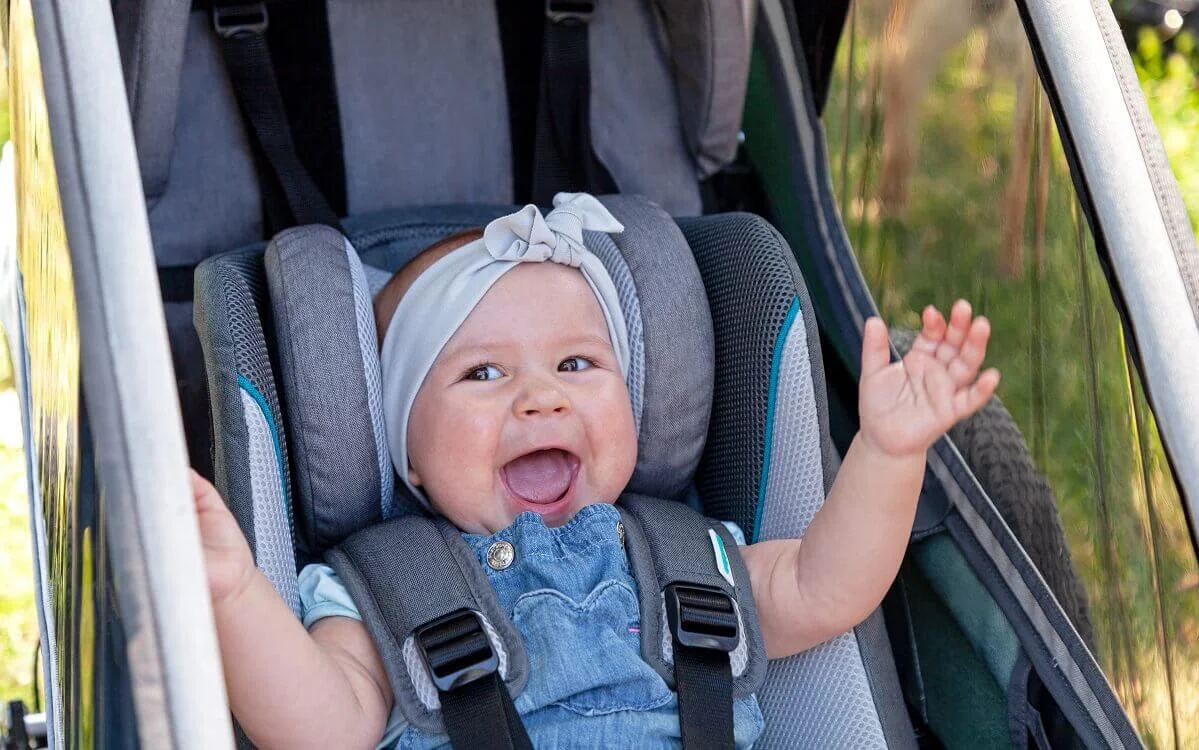
Our Qeridoo hammock offers babies from the 4th week of life a
comfortable lying surface in the bicycle trailer. It is suitable up to
an age of 12–14 months or 13 kilograms. The
hammock offers a flexible lying position that, thanks to adjustable
tilt angles, can be individually tuned to the baby's needs
.
The hammock is safely mounted in the dedicated attachment points
freely suspended in the trailer. This way
shocks are cushioned and a safe, comfortable ride is enabled.
Your baby thereby lies on a lying surface of about 73 × 30 cm,
similar to a classic hammock.
With the Qeridoo hammock, babies as young as the 4th week of life can already be transported in the bicycle trailer.
Safety, comfort and adaptability with the Qeridoo hammock
A special feature of the hammock is the aluminum safety frame that ensures stable side protection and
thus increases your child's safety during the ride. Thanks to the
lightweight material, the hammock is also particularly easy to
handle and space-saving to stow.
Bicycle trailer hammock - all advantages at a glance:
High safety: The padded 5-point harness system
secures the baby safely.
Ergonomic: Optimally supports head and back.
Additional protection: Height-adjustable headrest and side impact protection.
Comfort: Soft padding ensures comfort.
Easy mounting: Easy installation and removal in the trailer.
More information about the hammock
Gigantically good for baby transport: the new Qeridoo hammock Plus
In terms of comfort, the hammock offers more flexibility, since it
can be adjusted at different tilt angles and thus creates a
more pleasant lying position for the baby. Its gentle motion ensures
additional comfort and has a very soothing effect on babies.
The infant carrier on the other hand is fixed in one position,
but thanks to its ergonomic design and padding, also offers
high comfort. While the hammock is more adaptable due to its adjustable tilt
and gentle motion, the infant carrier scores with its
stable and safe posture.
If the bicycle trailer is often
used on uneven routes or on longer rides
, the hammock is the better choice due to its spring-like properties that
compensate shocks. It ensures that the
baby lies comfortably and safely even on bumpy paths.
In a trailer with baby transport system, your child sleeps comfortably even on uneven routes.
For shorter rides or use in the city, where the
surface is usually more even, the infant carrier offers the
necessary protection and comfort.
Space requirement and handling in comparison
The available space in the trailer is
a decisive factor when choosing between infant carrier and
hammock. Infant carriers are more compact and often leave more room for
luggage or additional passengers, which is an advantage in bicycle trailers
.
Hammocks do offer a larger lying surface for the baby,
but require more space and possibly additional adjustments
for optimal positioning.
Handling also plays a role: infant carriers are often easy to
install and remove, ideal for quick vehicle change.
Hammocks are also practical, but may require
a bit more fine-tuning. Particularly practical with the hammock is
that it can remain in the bicycle trailer when it is folded up
.
More tips
Tips for baby transport in the bicycle trailer
Regardless of whether you decide on an infant carrier or a hammock
, the safety of your baby in the bicycle trailer is of
utmost importance.
Your child should always lie stably and comfortably in the trailer.
Make sure the
infant carrier or hammock is correctly and stably installed in the trailer
. Check the safety harnesses regularly and make sure they
fit well and securely hold your baby.
On longer rides it is
important to take regular breaks to ensure
that the baby lies comfortably and no uncomfortable pressure points arise
.
Tip: Toys, stuffed animals and small snacks keep
your child entertained during the ride.
Ride calmly and evenly to ensure a safe ride for your child
. Avoid abrupt braking or rapid changes of direction
and best practice turning and braking beforehand, when no baby is on board
. As soon as your child can sit independently, they should absolutely
wear a helmet in the bicycle trailer
.
Our conclusion
Infant carrier or hammock in the bicycle trailer?
The choice between infant carrier and hammock depends on the individual needs of the baby and the conditions of use. Infant carriers offer more stability and are ideal for newborns,
while hammocks, thanks to their adaptability and larger
lying surface, are particularly suitable for older babies and longer rides on uneven
terrain.
Last updated: February 4, 2026
The soft, breathable surface of the hammock also provides a pleasant lying feel and supports an ergonomic positioning of the baby.
Tip: As soon as your child can sit independently, they no longer need a hammock or infant carrier. For petite children, the seat insert helps for an optimal hold in the child bicycle trailer. The bicycle trailer adapts to the growth of your child by the way, and is usually suitable up to about 4 to 5 years.
Discover more articles
Deepen your knowledge with our recommended articles
FAQ – The most frequently asked questions about baby inserts for the bicycle trailer
From what age may a baby ride in a bicycle trailer?
Our baby inserts can be used from the fourth week of life until your baby can sit up unaided. The Qeridoo baby inserts are approved for Buggy Mode and bike mode. The conditions for safe use apply, as stated in the user manual and on the respective product page.
These include, among other things, use only on paved paths, a maximum speed of 15 km/h and no more than 6 km/h on bends, as well as crossing curbs only at walking pace. Heavy braking is to be avoided.
Especially in the first months we recommend riding on paths that are as level as possible and looking well ahead, so as not to strain the child's back. The complete safety instructions are in the user manual for your baby insert, also at qeridoo.de/go/downloads.
What is the difference between the Baby shell and the Hammock in a bicycle trailer?
The Baby shell was optimized specifically for transporting babies in a bicycle trailer. It provides a firm, ergonomic lying position with a height-adjustable headrest, side impact protection and an adjustable 5-point safety harness. The Baby shell is suitable up to about 12 months or 12 kg.
The Hammock is suspended freely from the attachment points in the trailer and actively evens out vibrations. It offers an adjustable lying position through variable tilt angles and an aluminum safety frame for stable side protection. It is likewise secured with a 5-point harness and suitable up to about 12–14 months or 13 kg. One practical advantage: the Hammock can stay in the trailer when it is folded up.
Both systems can be used from the fourth week of life and are suitable for babies who cannot yet sit up unaided.
Which age is the Baby shell better suited to, and which the Hammock?
The Baby shell is the ideal choice for newborns and younger babies who still need a lot of support for head, neck and back. It is suitable for babies from the fourth week of life up to about 12 months or 12 kg.
The Hammock can likewise be used from the fourth week of life, but thanks to its adjustable tilt angles and larger lying surface it is particularly suitable for older babies who already have more body control. It is suitable for babies up to about 12–14 months or 13 kg.
Can a regular Maxi-Cosi or car seat be used in a bicycle trailer?
Yes, that is possible with the right accessories. Qeridoo offers a special adapter for car seat shells, with which the Qeridoo car seat shell or a compatible Maxi-Cosi can be safely installed in the bicycle trailer.
Important: installing a car infant carrier is only possible in the two-seater models Kidgoo 2 or Sportrex 2 – not in one-seaters.
How long can I use the baby insert in the bicycle trailer?
The Qeridoo Baby shell can be used up to about 12 months or 12 kg, the Hammock Plus up to about 12–14 months or 13 kg. As soon as the child can sit up unaided, switching to the regular seat is recommended. For more petite children the Qeridoo Seat reducer provides additional support during the transition.
How do I attach a Baby shell securely in the bicycle trailer?
The Baby shell is placed centrally in the trailer using a special attachment system, in order to maintain the best possible balance. All straps must be pulled tight and the attachment points checked for a secure hold before every ride. The floating suspension provides an additional cushioning effect that softens vibrations and shocks.
Can the baby insert for the bicycle trailer also be used in Buggy Mode?
Yes, both Qeridoo baby inserts can be used not only in bike operation but also in Buggy Mode. That is a big advantage over purely bicycle-specific accessory solutions: parents can go for a walk with the same insert without having to move the baby.
Which is ergonomically better for a baby in a bicycle trailer – Baby shell or Hammock?
Both systems were developed for a back-friendly, ergonomic posture and have been tested and certified by the Institute for Health and Ergonomics (IGR e.V.). The Baby shell supports the head and back particularly well thanks to its firm shape. For a natural lying posture we recommend unfolding the Hammock completely, so that the frame forms a straight line. Which version fits better ergonomically depends on the individual baby and its stage of development.
What should I bear in mind when jogging or cycling with a baby insert in the bicycle trailer?
Riding style and choice of route are decisive: abrupt braking and quick changes of direction should be avoided. On uneven terrain the Hammock is recommended because of its cushioned suspension. Regular breaks are important so that the baby lies comfortably and no pressure points develop. As soon as the child can sit up unaided, it should always wear a helmet in the trailer.